| « DUP - No 'Fair Deal' For Football | The Benefits of Cross-Community Co-Operation? » |
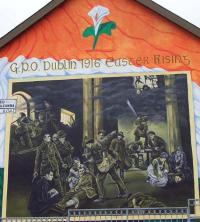
Nothing To Celebrate in Easter Rising

The timing seemed a bit late but last Friday saw an opinion piece by Kevin Myers in the Belfast Telegraph on the topic of Easter Rising celebrations. Criticising the preferred Irish narrative of the Rising and highlighting the double-standards of authors labouring over those Myers asks "What is there to celebrate about the cold-blooded slaughter of innocent people in the streets of Dublin?" What, indeed?
It seems almost inconvenient to the chosen narrative of the Irish national creation myth to ask questions like: "Who gave Volunteer Garry Holohan the right to very deliberately and fatally shoot a teenage boy named Playfair during a raid at the Phoenix Park magazine?" He points out that only one of the 'volunteers' had ever even sought election, and he was "roundly defeated" by the electorate in his quest for a council seat (yes, you heard right, Ireland did indeed have elections before they ceded from the UK).
He's just as critical of the objectives of the leaders of the rebellion as he is of their methods though, blaming them for the decades of economic stagnation that were a feature of the South up to the late 70s.
"It was only when we undid the isolationist consequences of the rising that we began to create a country which could give its children jobs at home rather than one-way tickets on the mailboat to the very land against which the rising had been fought.
The Celtic Tiger - an open economy, with free movement of capital, and with the immigration of hundreds of thousands of foreigners - is the very antithesis of what Pearse and Connolly had wanted. One sought a totalitarian Marxist state, the other a protected Gaelic paradise... ."
Given that there was going to be some kind of home rule most likely within a decade anyway (it eventually came 5 years after the rising), what exactly is there to celebrate?
Trackback address for this post
10 comments
So with a religious sense of duty the worldly reality becomes unimportant, meaning that they take it upon themselves to awaken the "heretics" and "non-believers", which is a central theme in the Easter Rising mythology.
In a similar way many people, including Loyalists, have a retrospective romantic and almost religious view of historical events - the Battle of the Boyne as an example - many ignorant Loyalists see it in simplistic religious terms as "King Billy beat the fenians" when the reality was vastly different to the facts.
King William's campaign was largely non-religious, secular even for the time period, indeed he had the Popes blessing and Catholic soldiers. So I don't want to condemn Republicans outright for their outlook on the Easter Rising, the problem I have is they see it as a license to commit further violence in the name of the Proclamation of the Republic, which means I cannot celebrate or justify its celebration.
Speaking of double standards, what is there to celebrate in Irish people going off to act as cannon fodder in an imperialist war? Nothing, yet Myers does celebrate this.
Despite public hostility at the time, within two years republicans won a majority of seats (in the 1918 election), and within five years the British were forced to sign the treaty.
So, CJ, if you want to put it in those terms ("to awaken the "heretics" and "non-believers") then I guess you wouldn't be far off the mark. SF won an overall majority within two years of the Rising, no myths/lies there.
It's also worth noting that the IRB and the Irish Citizen Army had very different worldviews as did Cumann na mBan. The forces that took part in 1916 were very diverse. Silly simplifications are intellectually lazy and self-serving.
To say that Connolly wanted a "totalitarian Marxist state" shows a frightening lack of knowledge. A mere leaf through Connolly's writings would confirm this.
"...blaming them for the decades of economic stagnation that were a feature of the South up to the late 70s"
This is nonsense. They were executed! How can you blame them, they were dead. Also, their visions were so diverse that even if they had lived who knows whose ideology would have prevailed.
Anybody who writes logically and objectively I'll read with an open mind. Myers is a chump.
JG - the them in the above quote is the objectives. The death of the men themselves sadly wasn't the end of their 'ideals'. Aside from the basketcase economics, the killing other Irishmen in the name of some twisted notion of "freedom" continued and/or continues.
"Myers offer nothing more than bias hyperbole."
Perhaps, but his 'bias hyperbole' is intended to counter the at least equally biased hyperbole that is commonly accepted as the "history" of 1916.
I happen to agree with you that there is nothing to celebrate about the rising. the Death (in particular) and destruction surrounding it were obscene. But Myers does not provide a reasoned analysis of the event. he is biased and his articles are just emotional rants. As you use his article as the basis for your post, i feel your post is also an unreasonable analysis, though i suppose it accurately reflects your own prejudices regarding Irish history.
Is there anything to celebrate in the deaths of Dubliners, or even the British soldiers? No. But that isn't what is being celebrated. Freedom and independence is something worth fighting for and dying for. The ideals of the Proclaimation are worth fighting for and dying for. If the men of 1916 had have lived and been successful, they would have been pulled apart by differing views. they would have had to make deals and become pragmatic. They didn't live though, and so are idealized because what is what 1916 commerations celebrate. The ideal.
Context matters. If 1916 had not have been part of repeated attempts by Irishmen to assert independence, if it had not been followed by the 1918 SF election victory and by the subsequent War of Independence then yes, it could be explained away by a few madmen with no mandate bringing violence. Those things did happen though, and many Republics have begun in violence; it is an unfortunate fact.
As I've already pointed out they (Pearse, Connolly and their respective organisations) didn't have the same ideals! I know this makes it a little more messy, complicated and generally more difficult to hold unto your simple view of the matter but it's the truth which I consider to be quite important.
"some twisted notion of 'freedom'"
What's twisted? Imperialism should be opposed. It was right to oppose it then and it's right to oppose it now (in the context of Britain and the US's murderous adventures).
Unionists always find this hard to accept but the men and women of 1916 weren't prepared to accept crumbs from the master's table (ie limited autonomy in the form of home rule). Independce, a right, wasn't going to be kindly given, we had to grasp it ourselves. It is highly unlikely HR would have been granted in any case as the Brits had proved time and again they couldn't be trusted on the issue. Also, we all know how unionists were going to respond had it been granted...
Actually Myers pointed that out in his piece too. I don't have a problem or an argument with that fact. Even my memory of 3rd year history includes the ICA who I remember as basically being communists amongst the more nationalist elements.
"What's twisted?"
The idea that the Irish were somehow unfree; to listen to the stories you'd think they didn't have free elections or favourably disproportional representation. Or to suggest the South wasn't going to get home rule anyway: as you know it was only waiting royal assent when war broke out. Since it took until 1921 anyway, I'm not sure it would have taken much longer had they waited.
"we all know how unionists were going to respond had it been granted..."
You're right, some amount of Northern Ireland/Ulster wouldn't have been part of it, but since we're not part of "it" (the South) anyway there was nothing gained on that front.
You also can't just say that the South wouldn't have moved to become a republic regardless of the rebellion. Nobody knows what might have happened in the intervening 16 years. The desire for a Republic could still have been there for some, and I doubt Britain would have stopped them if the people had decided on it - but again, that's all speculation.